

By Inayatullah Rustamani
There are moments when a school building becomes much more than bricks, cement and freshly painted walls. For a child who has studied in a crowded classroom, struggled without basic facilities or wondered whether education would continue beyond primary school, a better school can represent something far greater: a doorway to a different future. This is the deeper significance of the transformation taking place in government schools across Sindh under the leadership of Education Minister Syed Sardar Ali Shah.
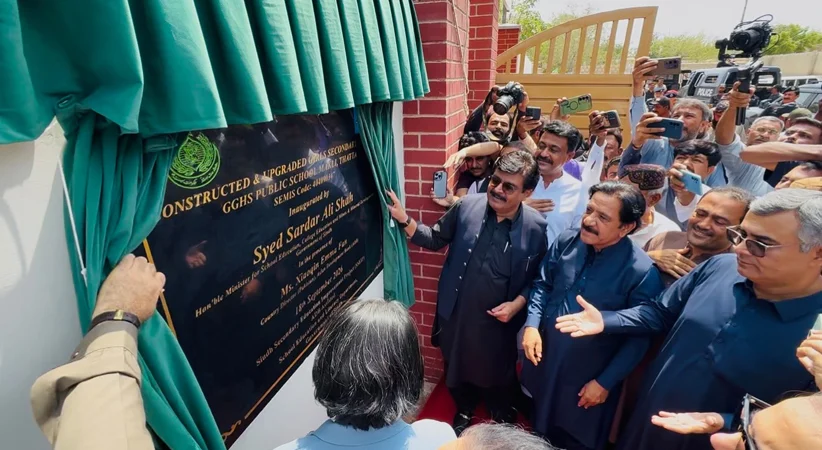
In Thatta, three upgraded school buildings have recently opened their doors to students, offering not simply renovated classrooms but a renewed sense of possibility. Government Girls Primary School Gharo-2, Government Girls Primary School Public School Makli and Government Boys Primary School Malik Musa Chauhan were inaugurated by Sindh Education Minister Syed Sardar Ali Shah and Asian Development Bank Country Director for Pakistan Emma Fan. The schools have been upgraded under the Sindh Secondary Education Improvement Project with support from the Asian Development Bank.
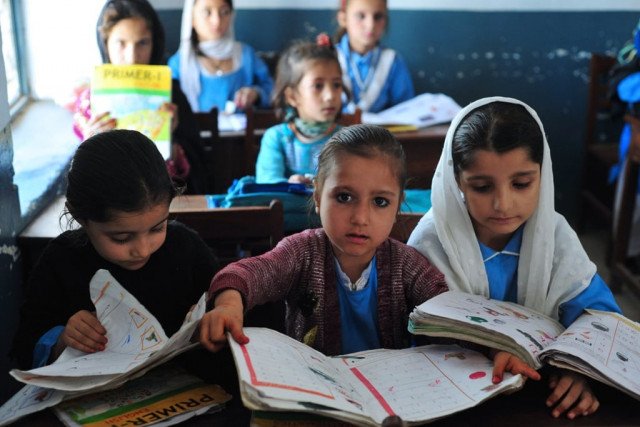
The significance of these developments goes far beyond the walls of the newly upgraded buildings. For Sardar Ali Shah, improving government schools is closely connected with a simple but powerful idea: a child studying in a public-sector school should not feel that he or she has been left behind. The minister has repeatedly emphasised the need to change the traditional perception of government schools and create institutions where children encounter an environment that supports their ambitions rather than reminding them of deprivation.
That philosophy is particularly meaningful in a province where millions of children depend on public education. A school is not merely a place where a teacher delivers lessons, but it is an environment where a child’s confidence is shaped, curiosity is developed and dreams begin to take form. The quality of the classroom, availability of clean drinking water, access to technology, functioning laboratories and the overall condition of the school influences how a child experiences education.
It is a bitter reality that a child may forget anything else years later, but the feeling of being valued and given an opportunity can remain for a lifetime. This is the reason that the upgrading of schools deserves to be viewed as an investment in human potential rather than simply an infrastructure programme. The Sindh government has reported that more than 2,000 schools have already been upgraded to enable students to continue their education beyond the primary level, with an ambition to increase this number to more than 10,000. Such an expansion is particularly significant for girls, because the availability of post-primary education closer to their homes can help reduce barriers that otherwise force many young students to discontinue their studies.
A school in a village or small town can determine whether a girl remains in education or leaves school after primary level. It can determine whether parents feel confident about sending their daughters to continue their studies. And it can determine whether a talented child gets the opportunity to become a doctor, teacher, engineer, civil servant, entrepreneur or researcher.
The new facilities being introduced under the Sindh Secondary Education Improvement Project are intended to make that possibility more realistic. The project includes the construction of 116 modern secondary school buildings in 10 southern districts of Sindh, including Thatta, Sujawal, Badin, Tando Muhammad Khan, Tando Allahyar, Mirpurkhas, Umerkot, Tharparkar, Sanghar and Matiari. The facilities include modern science laboratories, computer and IT laboratories, separate staff rooms and washrooms, solar power systems, water filtration plants and electric water coolers. For an official document, these may appear to be simple infrastructure components. For a student, they can mean something deeply personal: access to clean drinking water, a more comfortable learning environment, practical science education, exposure to technology and the dignity of studying in a properly equipped institution.
Imagine a student entering a science laboratory for the first time. For many children, science exists only in textbooks. Words such as laboratory, experiment, technology and computer can seem distant and abstract. But when a child actually enters a laboratory and experiences practical learning, education can change from memorisation into discovery. That moment of discovery can influence the ambitions of a young mind for years to come.
Yet a modern building alone cannot transform education. Schools ultimately come alive through their teachers. That is why the reported introduction of a new cadre of science teachers, including the recruitment of 8,000 teachers, is an important part of the wider effort. A laboratory without a capable teacher is only a room filled with equipment, while a dedicated teacher without adequate facilities may struggle to provide students with the learning experience they deserve. Bringing teachers, infrastructure and technology together creates the possibility of a more meaningful educational environment.
Sindh’s educational challenges, however, cannot be discussed without acknowledging the enormous damage caused by the devastating floods. According to the minister’s remarks, around 20,000 schools were affected. The rehabilitation of such a vast educational infrastructure is a task that cannot be completed overnight. Every damaged school represents interrupted lessons, teachers working under difficult conditions and children whose educational journey can be placed at risk.
Rebuilding these schools is therefore not simply a construction exercise. It is an effort to restore continuity to the lives of children whose education has already been disrupted. It is also an opportunity to rebuild schools in a manner that addresses longstanding deficiencies and provides students with facilities appropriate for modern education.
The minister has also called for greater federal participation in the rehabilitation effort, stressing the importance of collective responsibility for the education of children in Sindh. His emphasis on a strong federation and greater cooperation reflects the scale of the challenge: rebuilding thousands of schools and improving education for millions of children requires sustained commitment and resources.
At the same time, the most meaningful way to understand these initiatives is not through numbers alone. Behind every figure is a human story. One upgraded girls’ school can mean a daughter remaining in education. One science laboratory can inspire a child to pursue medicine or engineering. One computer laboratory can introduce a rural student to opportunities that previously seemed impossibly distant. One water filtration plant can make a school healthier and more welcoming. One solar system can help a school continue functioning despite electricity challenges. And one committed teacher can influence the future of an entire generation.
This is why the real measure of educational reform should ultimately be what happens inside these buildings. New classrooms matter, but what happens in those classrooms matters even more. Laboratories matter, but the curiosity they inspire matters most. Teachers matter, but the confidence they build in their students is the lasting achievement.
The three schools inaugurated in Thatta should therefore be seen as part of a broader effort to reshape the public education experience in Sindh. The road ahead remains challenging. Thousands of schools require attention, teachers need continuous support, learning outcomes must improve and children who remain outside the education system need to be brought into classrooms. No single project can solve all these problems.
But meaningful educational transformation is rarely achieved through one project. It is built gradually—school by school, classroom by classroom and child by child.
That is what makes the developments in Thatta worth celebrating. These schools may appear to be individual buildings on a map, but for the children who study there, they can become something much bigger: places where dreams acquire a classroom, curiosity finds a laboratory and education begins to feel like a genuine pathway to a better life.
Ultimately, the success of any education minister cannot be measured only by the number of inauguration ceremonies held or buildings completed. Its deeper measure will emerge years later, when a girl from a modest family becomes the first graduate in her household, when a student discovers a passion for science inside a school laboratory, when parents begin to believe that a government school can provide their children with a promising future, and when children walk through the gates of a public school with confidence rather than a sense of deprivation.
The vision articulated by Syed Sardar Ali Shah continues to translate into sustained improvements in classrooms, teachers, facilities and learning opportunities, the greatest achievement will not simply be the number of schools upgraded, but it will be the number of children who leave those schools believing that their circumstances do not have to determine their destiny.
In the broader perspective, when a school stops being merely a building. it becomes a promise.
The Writer is a Columnist and and runs the website : www.englishforcss.com
X: @inayatullah26


Leave a Reply