

Feb. 26, 2026 | Islamabad
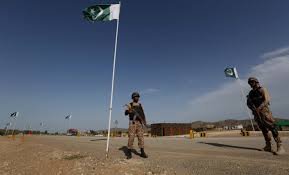
Pakistan signaled on Wednesday that it would maintain — and potentially intensify — its current policy toward Afghanistan unless Taliban authorities abandon what it described as a “guerrilla mindset,” days after Pakistani airstrikes inside Afghan territory sharply escalated tensions between the two neighbors.
Over the weekend, Pakistan carried out what officials described as intelligence-based strikes in Afghanistan’s Nangarhar and Paktika provinces. Islamabad said the operation targeted camps belonging to Tehreek-e-Taliban Pakistan (TTP), its affiliates and fighters linked to Islamic State.
Pakistan has long accused the Afghan Taliban government of allowing militant groups to use Afghan soil to launch attacks against Pakistani civilians and security forces — an allegation Kabul denies.
Speaking to Geo News, State Minister for Interior Talal Chaudhry said Islamabad had tried dialogue but would now persist with “practical steps” if the Taliban leadership failed to change its approach.
“They call themselves a state, but they have not yet emerged from their guerrilla mindset,” Chaudhry said. “Now, with the practical steps we are taking, we want to change their behavior and see them in the form of a state.”
Rising Tensions Along a Volatile Border
Pakistan blamed a recent wave of suicide bombings in Islamabad, Bajaur and Bannu on militants allegedly operating from Afghan territory. The cross-border strikes marked one of the most significant escalations in months between the two countries, whose 2,600-kilometer frontier has long been a flashpoint.
In October last year, clashes between the two sides led Pakistan to temporarily close key border crossings, disrupting bilateral and transit trade. The frontier remains critical for commercial and humanitarian flows.
Chaudhry described Afghanistan as “an irresponsible neighbor” and warned that Pakistan’s hard-line approach would continue if attacks inside its territory persisted.
“This war will be won, and all this will end,” he said. “If it is not resolved the straight way, then it will be completely ended by a hard-line approach.”
Taliban Denies Militant Presence
The Taliban government in Kabul condemned the airstrikes as violations of Afghan sovereignty and said civilians were killed.
In an interview with Al Arabiya, Taliban spokesman Zabihullah Mujahid pledged a military response.
“It would be a military response, but its details are confidential and I cannot explain further,” Mujahid said.
He rejected Pakistan’s accusations that TTP or Islamic State militants operate from Afghan soil, arguing instead that Pakistan’s security challenges are domestic in origin. “Afghan soil is not allowed to be used against anyone,” he said, adding that Taliban authorities had conducted extensive operations against Islamic State fighters inside Afghanistan.
Regional Mediation Efforts
The renewed hostilities threaten to further destabilize relations between the two neighbors, whose ties have been strained since the Taliban’s return to power in 2021. Several regional countries, including Saudi Arabia, Türkiye and Qatar, have sought to mediate between Islamabad and Kabul in recent months.
Whether those diplomatic efforts can contain the latest escalation remains uncertain. For now, both sides appear entrenched — Pakistan insisting on forceful deterrence, and the Taliban signaling readiness to respond in kind — raising fears of a broader confrontation along one of South Asia’s most volatile borders.



Leave a Reply