

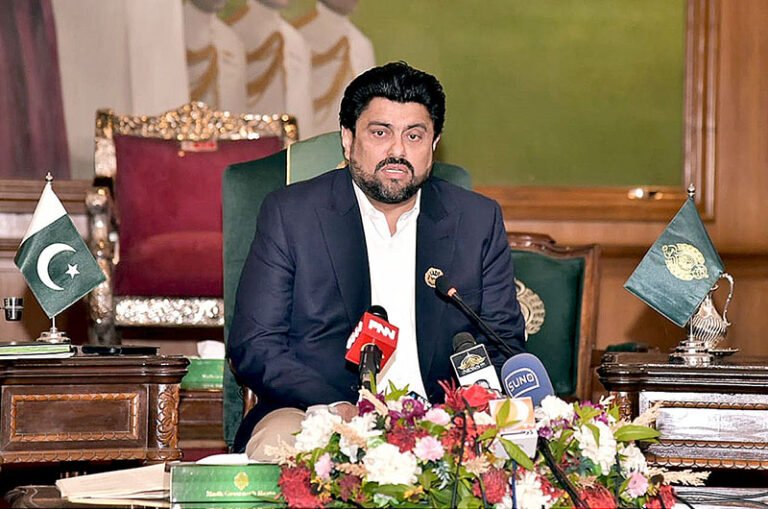
The recent demand by the Pakistan Peoples Party (PPP) for the removal of Sindh Governor Kamran Tessori underscores a continuing tension in the province’s political landscape, raising questions about constitutional roles, political etiquette and the perception of institutions.
Governor Tessori, who holds the post since October 2022, was appointed with broad consensus among political partners at the time. Traditionally, the office of a provincial governor in Pakistan is regarded as a non‑political constitutional position, intended to act as a representative of the federation rather than an active political actor. Yet recent statements by PPP leaders reflect unease over how the Governor House in Karachi is being used and interpreted.
The core of the PPP’s criticism, as articulated by provincial ministers Saeed Ghani and Sharjeel Inam Memon , revolves around allegations that the Governor House has been turned into a venue for political messaging rather than a neutral symbol of constitutional authority. They have warned against a resurgence of divisive politics, particularly along linguistic lines, and urged Prime Minister Shehbaz Sharif to appoint a governor who aligns with the Federation’s and Sindh’s interests.
Governor Tessori has responded by affirming his commitment to public service and insisting that his actions are not exclusionary. He has stated that he stands for the rights of all communities and rejects any notion that the Governor House is used to discriminate against any group.
These exchanges shed light on a broader issue that often surfaces in Pakistan’s federal‑provincial dynamics: the challenge of separating constitutional offices from the theatre of partisan politics. While political figures naturally advocate for their positions, institutions like the governor’s office are expected to be above political fray, acting instead as custodians of the Constitution and provincial dignity.
Critics of the governor have pointed to a range of activities ranging from public diplomacy to social outreach and have questioned whether these blur the lines of neutrality. Supporters, however, argue that a more visible and engaged governor can bridge gaps between provincial needs and federal resources, particularly in a diverse province such as Sindh.
It is equally important to acknowledge that political parties in Sindh, especially the PPP, bear longstanding responsibility for governance in the province.
The way forward requires clarity in defining institutional roles, especially in a federation where symbolism and substance often intersect. Political disagreements are natural in any vibrant democracy, but they should be anchored in respect for constitutional norms. The governor’s role, in particular, should be upheld as a unifying office, not one that becomes a battleground for political point‑scoring.
Ultimately, the stability of Sindh’s governance — and public confidence in its institutions — depends on a shared commitment by all stakeholders to democratic norms and constitutional propriety rather than temporary political advantage.




Leave a Reply