

Feb. 26, 2026 | Peshawar
Pakistan’s disaster management authorities on Thursday issued a warning of an elevated risk of glacial lake outburst floods (GLOFs) in the northern regions of the country, citing rising temperatures and early heatwave conditions that could accelerate snow and glacier melt.
The National Disaster Management Authority said seasonal forecasts for March through June 2026 indicate above-average temperatures, particularly in the Gilgit-Baltistan region and upper Khyber Pakhtunkhwa, raising the likelihood of sudden breaches in natural glacial dams.
GLOFs occur when water trapped in glacial lakes exceeds the stability of its natural barrier, often leading to catastrophic downstream flooding. Such events can strike with little warning, carrying debris, rocks, and ice at high velocity, posing a significant threat to communities, infrastructure, agriculture, and transport networks.
“Increasing temperatures during March to June 2026 may accelerate snow and glacier melt in Gilgit-Baltistan and Upper Khyber Pakhtunkhwa, heightening the risk of GLOF incidents,” the NDMA said. “Such events can trigger flash floods, causing damage to homes, infrastructure, agriculture, communication networks and may result in human casualties in vulnerable downstream communities.”
High-Risk Areas
Authorities identified valleys and settlements in Gilgit-Baltistan, including Ishkoman, Gulkin, and Gulmit, as particularly vulnerable. In upper Khyber Pakhtunkhwa, parts of Chitral and Upper Dir were also highlighted as potential flashpoint zones.
The NDMA urged provincial and local governments to review and update contingency plans, reinforce early warning systems, and establish evacuation arrangements where necessary. Residents living near glacial streams were advised to stay vigilant, avoid unnecessary travel in high-risk areas, and closely follow instructions from disaster authorities.
Climate Change Context
Pakistan is considered among the world’s most climate-vulnerable nations, despite contributing less than 1 percent of global greenhouse gas emissions. The country has faced repeated climate-induced disasters, including devastating floods, prolonged droughts, and record-breaking heatwaves, which have claimed thousands of lives, damaged critical infrastructure, and exacerbated food insecurity.
Experts say the combination of rising temperatures, receding glaciers, and unplanned settlement in river valleys has intensified the risk of GLOFs in recent decades. According to climate models, the Karakoram and Himalayan glaciers feeding northern Pakistan’s rivers are increasingly unstable, with ice melt accelerating during unusually warm springs.
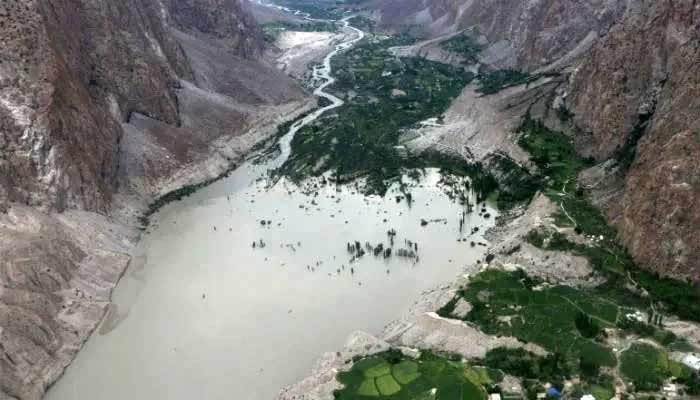
Boats on Attabad Lake in Gilgit-Baltistan, which was formed after a landslide in 2010, serve as a stark reminder of how natural disasters in glacial regions can reshape local geography and livelihoods. Local officials have emphasized the need for early-warning systems, monitoring, and community preparedness to mitigate potential loss of life.
“The risk is not hypothetical,” said a provincial disaster management official who requested anonymity. “Even a small glacial breach can cascade into a major flood affecting tens of thousands downstream within hours.”
Preparing for the Future
The NDMA’s advisory stressed coordination between federal, provincial, and local authorities, calling for rapid deployment of monitoring technologies, river gauges, and communication channels to alert vulnerable communities. Emergency response teams are being put on heightened readiness to respond to any incidents.
As Pakistan confronts rising climate hazards, the warning about GLOFs adds to growing concerns about water-related disasters and the broader challenge of adapting infrastructure and communities to the impacts of global warming. Analysts say long-term mitigation will require investment in early-warning networks, resettlement planning for high-risk zones, and strengthened climate resilience across northern Pakistan.










Leave a Reply